
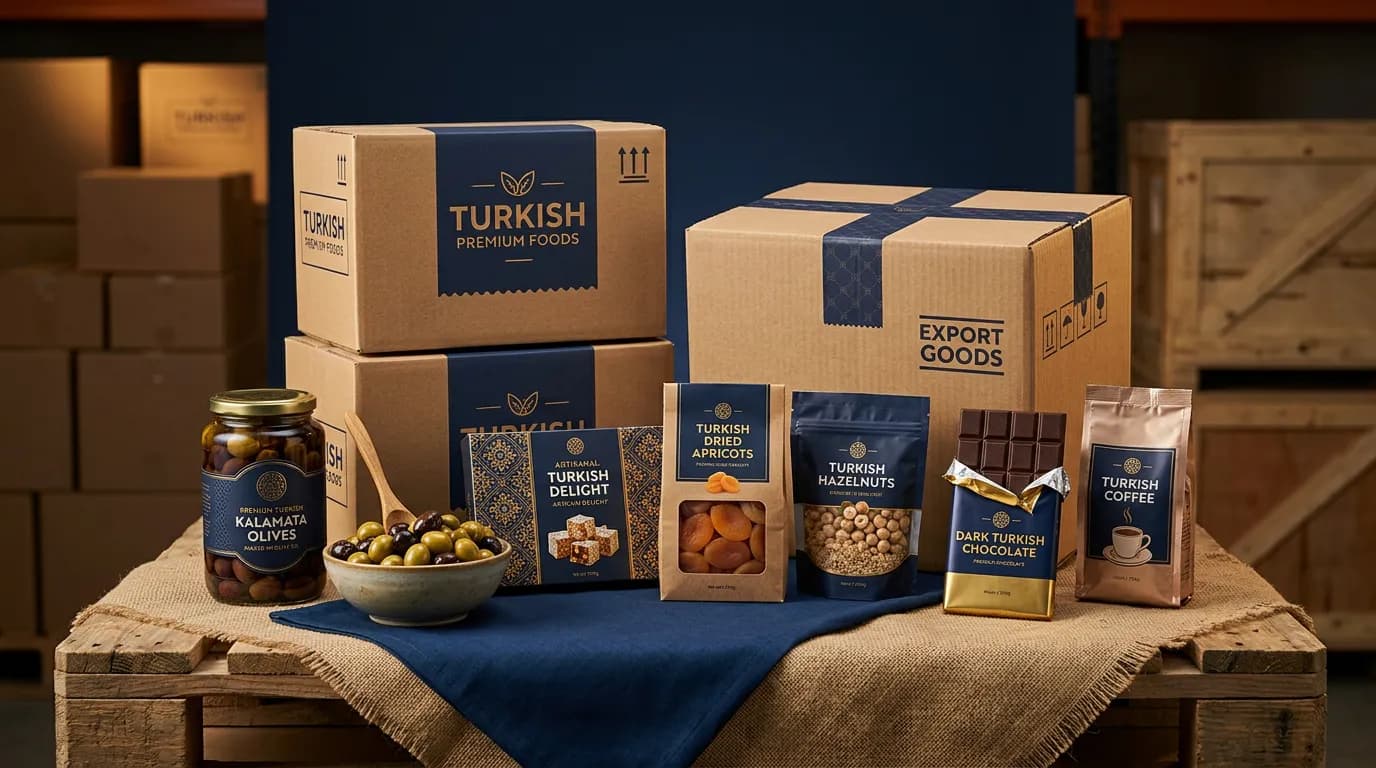
Everything you need to know about packaging, certificates, halal documentation, common mistakes and cost planning when exporting olives and chocolate.
Global Demand for Turkish Food
Turkish olives, chocolate and other food products enjoy a strong reputation in world markets for their quality and taste. Russia and the countries around the Black Sea are among the fastest-growing markets for these products. Geographic proximity, established taste preferences and retail chains looking to diversify their suppliers keep feeding this demand.
Food export offers high potential, but it demands more care than other product groups due to regulations, shelf life and cold chain requirements. A single missing document or an incorrect label can leave an entire consignment waiting at customs. Proper preparation is the key to a lasting presence in these markets.
For a company entering this field, success begins long before the first shipment. Researching which package sizes and product formats sell in the target market, building relationships with distributors and learning the regulatory requirements in advance are the essential steps. Exporters who do this groundwork solve from the start the problems their competitors struggle with for months.
Certificates and Quality Documents
The indispensable document of food export is the health certificate issued by the competent authority. It is accompanied by microbiological and chemical analysis reports and the registration and approval numbers of the producing facility. The food authority of the destination country uses these documents to trace where and under what conditions the product was made.
In markets with large Muslim populations, halal certification is a significant competitive advantage; for products like chocolate, the ingredient declaration is examined especially carefully. ISO 22000 or HACCP certificates give buyers food safety assurance. Large retail chains very often require these system certificates as a precondition.
Consistency between documents matters as much as the accuracy of their content. Product names, lot numbers and weights on the invoice, packing list, health certificate and analysis reports must match exactly. Customs administrations cross-check this information, and even a small discrepancy can hold a shipment for days.
Halal Certification Step by Step
Halal certification covers not only raw materials but also additives, production lines, cleaning chemicals and storage conditions. The certifying body evaluates the product and the process as a whole. Preparation should therefore start not with reviewing the ingredient list but with examining the entire production flow.
The process usually begins with an application to an accredited body, followed by a facility audit, a review of ingredient and supplier documentation, issuance of the certificate and periodic surveillance audits. Keeping complete records at every stage both speeds up the audit and makes renewal periods easier.
For chocolate, emulsifiers, flavourings and confirmation that the product is free of gelatine are the most critical points. Whether the certifying body is recognized in the target market should also be a selection criterion, since not every country accepts every certifier. Clarifying with the buyer before export which body's certificate will be accepted prevents unpleasant surprises later.
Packaging and Shelf Life
For olives, packaging types such as glass jars, tins and vacuum pouches are chosen according to the consumption habits of the target market. Some markets prefer large tins, while retail shelves favour small glass jars. Labels must state ingredients, nutritional values and expiry dates in the language of the destination country.
Chocolate is temperature sensitive; summer shipments require temperature-controlled containers or insulated packaging. Temperature fluctuation causes bloom on the surface of chocolate, and even though the product remains technically safe, it becomes unsellable. Correct packaging preserves shelf life and eliminates the risk of returns.
In sea transport, secondary packaging is at least as important as primary packaging. Cartons must be strong enough to bear stacking loads, pallets must be wrapped properly and moisture barriers should be used for humid ship holds. Weak cartons get crushed during port handling, and damaged packaging on arrival costs reputation with the buyer even if the contents are intact.
Labeling Rules and Common Mistakes
The most frequent mistake is omitting mandatory fields when translating the label. Importer details, the format of production and expiry dates, storage conditions and origin information are subject to different rules in every market. Even a detail that looks trivial, such as the wrong date format, can be grounds for rejection at customs.
Another widespread mistake is a difference between the sample and the production batch. Buyers test the product in the destination country against the sample; a small deviation in weight, ingredients or packaging undermines trust and can count as a breach of contract. Whatever was sent as a sample must be shipped identically in series production.
The safest protection against these mistakes is to prepare a label dossier approved by the importer before printing. Approved label specimens, analysis reports and batch records should be archived systematically. When a problem arises, these records quickly show where responsibility lies and make resolution easier.
Cost Factors in Food Export
The cost of food export consists of far more than the price of the product. Packaging and label printing, certification fees, laboratory analyses, freight, insurance and customs charges make up the total cost. All of these items must be taken into account when preparing a quotation; otherwise the profit margin exists only on paper.
Some certification and analysis expenses recur with every shipment, while others are covered by annual certificates. Knowing which document is per consignment and which is periodic is a precondition for calculating unit cost correctly. Exporters who ship regularly spread these fixed expenses over more consignments and lower their unit cost.
Packaging choice directly affects freight efficiency. Glass jars are prestigious but heavy; tins are lighter and more robust. The balance between presentation quality and transport cost has to be struck separately for each market, because for some buyers the shelf appearance is decisive and for others the delivered price.
A Real-World Scenario
Imagine an olive producer in the Marmara region that wants to supply a retail chain in Russia. The chain demands labels in its own language, halal certification and a guarantee of regular delivery. The producer is exporting at this scale for the first time and does not know where to begin.
The correct sequence works like this: first the validity of existing certificates in the target market is checked, applications are filed for the missing documents and the label design is submitted for the importer's approval. Then suitable packaging is selected for a trial consignment and the shipment is planned on a Black Sea line departing from the Marmara ports. Because the documents are fully prepared before loading, customs clearance proceeds without problems.
The lesson of this scenario is clear: the exporter who completes document preparation before logistics minimizes the risk of delays and penalties. The chain that receives its first delivery smoothly repeats the order, and the relationship turns into a regular trade lane. In food export the first shipment is an exam; the company that passes wins a lasting market.
Expert Tips for First-Time Exporters
Keeping the product range narrow at the first step is the healthiest strategy. Getting certification, packaging and logistics right for one or two products produces results far faster than wrestling with ten products at once. One successful product line creates a ready-made infrastructure for the products that follow.
Working with a customs broker and a freight partner experienced in food shortens the learning curve considerably. Food regulations differ from the rules for general goods, and border controls are stricter. A partner who knows this field sees problems before they appear.
Keeping retention samples from every shipped batch is the strongest evidence in case of a dispute. Responding to buyer questions quickly and with documents also reinforces trust. In the food trade, reputation is earned slowly but can be lost with a single badly handled complaint.
Logistics and Market Strategy
Black Sea shipping lines bring food products to the Russian market quickly and at low cost. Short transit time is a decisive advantage for shelf-life-sensitive products. The earlier the product reaches the shelf, the longer the usable life offered to the consumer.
Different port pairs such as Karasu to Rostov, Ünye to Temruk and Marmara to Temruk can be chosen according to the buyer's region. Selecting a destination port close to the buyer's warehouse shortens the inland leg and reduces the total cost. Port selection is a decision that deserves as much attention as the freight negotiation.
Seasonal planning is also part of the strategy. Chocolate shipments need extra precautions in the warm months, while for olives the harvest season sets the rhythm of production and stock. An exporter who builds the annual shipping calendar around these cycles both protects quality and strengthens its hand in freight planning.
Outlook and Next Steps
Demand for Turkish food products in the markets around the Black Sea is expected to keep developing. Exporters who invest in quality documentation and the right packaging are positioned to take the largest share of this growth. Those who enter the market early and well prepared secure a lasting place in distributor networks.
Food regulation is not static; labeling rules, additive lists and border control practices are updated over time. Following the regulations regularly is continuous work, not a one-off preparation. An exporter who does not stay current may find that paperwork which passed without issue yesterday is held at the border tomorrow.
Novi Mühendislik manages the export of Turkish food products, including olives and chocolate, from certification to delivery. With its vessel operations on the Black Sea lines and its customs experience, it offers end-to-end support to companies planning their first shipment. If you are considering starting food export or growing an existing lane, you can contact our team at the planning stage.


